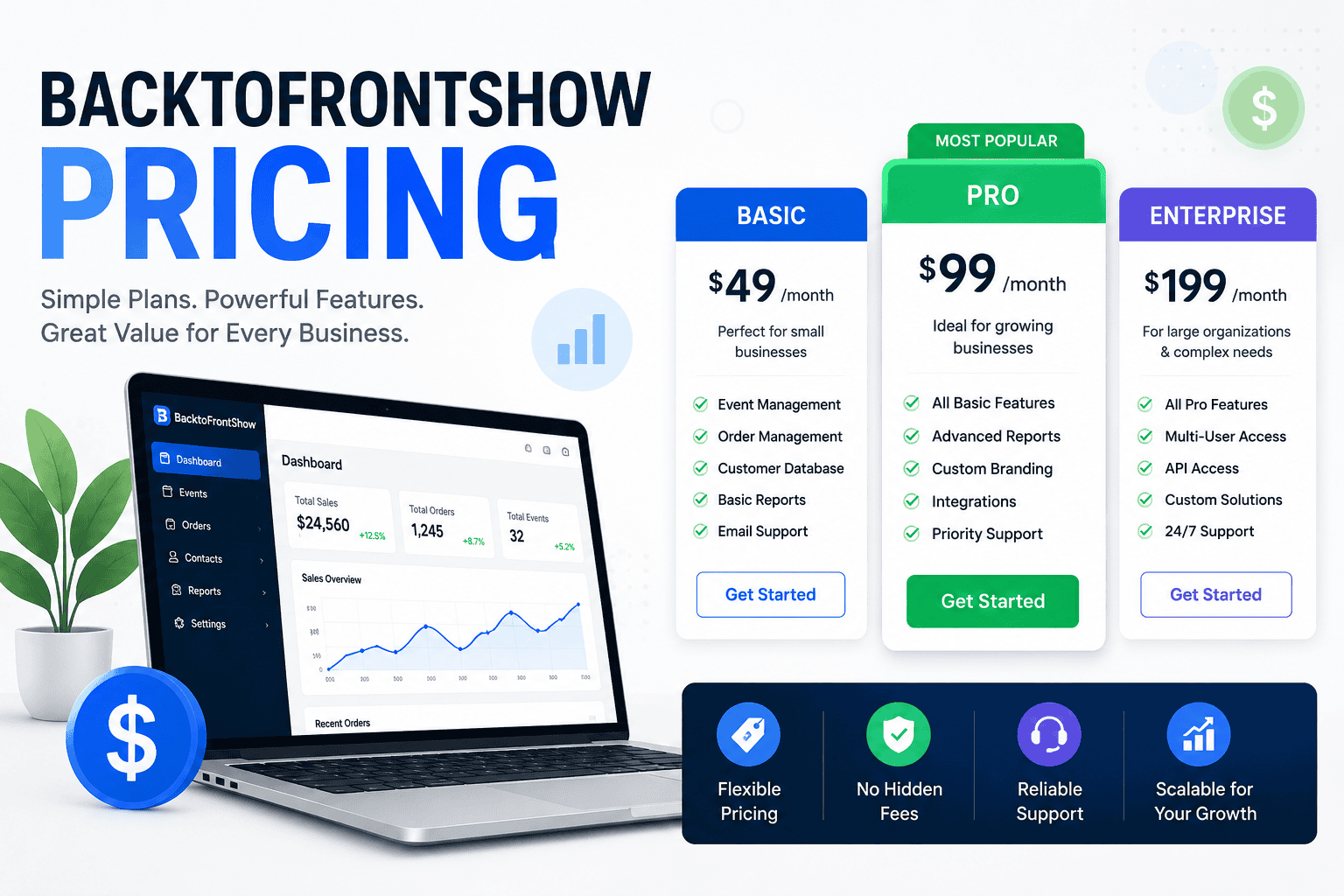
introduction
backtofrontshow pricing becomes quite difficult to comprehend when you are comparing business software, creative services, or event solutions. Pricing is never dictated by a single aspect.
For business people seeking to purchase a back to front show, it is advisable to move beyond the price that is offered. For a proper price decision, the business models, services available, expected returns, and resources required should be considered.
In this article, we explain how the important pricing factors of backtofrontshow pricing work and discuss how to compare the prices effectively.
The most common question in the mind of business people is always, “How much?” The real question that should be asked is “What do I get for my money?”
What Is BacktoFrontShow Pricing?
At its simplest, BacktoFrontShow pricing refers to the way costs are structured for the services, features, experiences, or solutions associated with the platform or offering. The exact amount a customer pays can depend on the selected package, requirements, service scope, and commercial terms.
Businesses may begin with back to back pricing comparisons, but a direct price comparison does not always provide an accurate picture of value. For example, a venue back glass price or a front and rear alignment cost may appear in unrelated searches and should not be confused with software or show-service pricing.
How Does BacktoFrontShow Pricing Work?
There are many factors that might influence the final cost of the business or event solution.
Features and Service Requirements
Basic packages can have standard features, whereas high-end packages can have enhanced services, advanced support, integration features or more resources. A proper feature comparison will give a clear idea about how exactly different packages vary.
It is also important to review an offerings comparison among different providers. Comparing features without considering the overall services could result in wrong purchases.
Business Size and Usage
Small organizations may have different requirements from large companies A solution that will be used by a small number of people might have a different cost structure from one that is meant for a bigger team.
Usage can impact the cost through usage-based pricing, monthly subscriptions, or transaction fees. Companies need to determine the usage expectations before deciding on the plan.
Service Complexity
Creative or professional requirements can increase costs. Creative Services, Audio Production, Content Creation, Artistic Direction, Experience Design might require specialists as well as other resources.
Expert Consultations, Workshops, Guest Speakers, Custom Production could all be part of the budget consideration.
Understanding different pricing models makes it easier to evaluate whether a pricing structure is appropriate.
What Influences BacktoFrontShow Pricing?
Subscription pricing involves customers paying on a regular basis such as monthly or yearly. Monthly subscription could help predict expenses while annual pricing could be more beneficial to customers that will subscribe for a longer period.
Companies need to compare different subscription plans and calculate the total cost of ownership rather than the subscription fee.
Tiered PricingPricing tiers divide services into different packages. A basic option may suit smaller customers, while premium levels can provide more advanced functionality.
This approach provides flexible pricing because customers can choose an option that matches their needs.
Usage-Based Pricing
With usage-based pricing, customers pay according to consumption. This may be useful when usage varies significantly between customers.
However, buyers should estimate potential usage and understand any additional costs before committing.
Freemium Model
A freemium model provides basic functionality without charge while premium features require payment. This can allow potential customers to test a service before making a financial commitment.
How to Evaluate BacktoFrontShow Pricing
A good evaluation begins with a clear needs assessment. Identify what your organization actually requires before comparing plans.
Consider the following:
- Required features
- Number of users
- Expected usage
- Support requirements
- Integration needs
- Contract duration
- Additional services
- Upfront costs
- Recurring expenses
- Potential expansion
These factors provide useful evaluation criteria and prevent businesses from selecting a plan simply because it has the lowest advertised price.
The Effect of BacktoFrontShow Pricing on Business Value
Price should always be considered alongside value. A cheaper service may not necessarily produce better financial results.
A useful value proposition explains what customers gain from a service. This may include time savings, better workflows, stronger customer relationships, improved reporting, or increased revenue.
Businesses can use return on investment calculations to determine whether an investment is financially worthwhile.
For example, if software reduces manual work and allows employees to focus on higher-value activities, the savings may justify a higher subscription cost.
Is BacktoFrontShow Pricing Worth It?
A detailed cost analysis helps reveal where money is being spent.
Potential expenses can include:
- Operational costs
- Overhead costs
- Variable costs
- Logistics costs
- Licensing fees
- Consultation fees
- Hosting services
- Human resources
- Project management
- Quality assurance
Separating these costs makes justification of costs easier and helps management understand the real financial impact.
A business can also perform job costing to determine the cost associated with individual projects or services.
Pricing Strategy and Profitability
A successful company needs more than revenue. It also needs healthy profit margins and sustainable operations.
Businesses can conduct margin analysis to understand how much profit remains after expenses. Break-even analysis can then identify the point at which revenue covers total costs.
A strong pricing strategy may include:
- Promotional pricing
- Volume discounts
- Group pricing
- Membership pricing
- Time-based pricing
- Dynamic pricing
- Exclusivity pricing
- Wholesale pricing
- Global pricing
The appropriate approach depends on customer expectations, market conditions, and the company’s objectives.
Understanding Customers Before Setting Prices
Customer research is essential. Businesses need to understand customer feedback, willingness to pay, and changing expectations.
Market segmentation can separate customers according to characteristics, needs, or purchasing behavior. Audience targeting can then help businesses communicate relevant offers to the right groups.
A target audience may respond differently to the same price depending on perceived value.
Businesses should also use user feedback, qualitative feedback, and feedback loops to continuously improve their offers.
Competitor and Market Analysis
Pricing should not happen in isolation. Competitor pricing provides useful context, while market analysis reveals broader industry conditions.
Companies can examine industry standards, customer expectations, and trends in pricing before making decisions.
Demand forecasting and forecasting tools can help predict how changes in price may influence demand.
A company can also use quantitative analysis and data analysis to identify patterns rather than relying only on assumptions.
Marketing and Customer Acquisition Costs
Pricing is closely connected to marketing. Businesses may invest in digital marketing, social media marketing, email marketing, marketing automation, and influencer partnerships to attract customers.
Other approaches include awareness campaigns, guerilla marketing, xenial marketing, and word-of-mouth marketing.
The cost of acquiring customers should be included in financial planning. Businesses can monitor conversion rates, lead generation, and new customer acquisition to determine whether marketing investments are producing results.
Yelp reviews can also provide customer insight for businesses where public reviews influence purchasing decisions.
Measuring Pricing Performance
A pricing strategy should be measured after implementation. Useful key performance indicators can show whether pricing decisions are producing the expected results.
Businesses can monitor:
- KPI tracking
- Performance metrics
- Engagement metrics
- Success metrics
- Quality metrics
- Metrics for success
- Retention strategies
- Customer acquisition
- Revenue growth
- Profitability
- Customer satisfaction
Insights and analytics can turn this information into practical business decisions.
Regular quarterly reviews can help organizations identify problems early and make adjustments.
Negotiating Better Pricing
In some situations, customers can negotiate commercial terms. Contract negotiation can be especially useful for larger purchases or long-term agreements.
Helpful negotiation tactics may include comparing competing offers, discussing contract length, reviewing included services, and asking about volume discounts.
Businesses should also examine long-term contracts, delivery options, warranty options, and guaranteed pricing before signing an agreement.
A clear rate card can make the commercial discussion easier by showing how individual services are priced.
Pricing, Operations, and Technology
Pricing decisions are also connected to operational efficiency. Workflow management, team collaboration, and technology integration can reduce unnecessary work.
Businesses should consider resource allocation, vendor management, and supply chain management when calculating the full financial impact of a service.
Online platforms may reduce administrative costs, while website optimization can improve the customer journey and increase conversions.
A strong user experience can also improve customer satisfaction and retention.
Sustainable Pricing and Long-Term Growth
Sustainable pricing focuses on maintaining a healthy balance between customer value and business profitability.
This guide provides information on BacktoFrontShow pricing and explains the main factors that need to be considered while analyzing various plans of this business software. It considers pricing model, business value, recurrent cost, scalability, and comparison criteria.
Businesses should also consider scalability. A pricing model that works for a small organization may become inefficient as the company grows.
A go-to-market strategy, growth strategies, and monetization strategies should therefore be aligned with the pricing structure.
Special Pricing Considerations
Different industries may require different approaches. Local pricing strategies can reflect regional purchasing power, while jurisdictional pricing may be influenced by legal or tax requirements.
Companies operating across geographic areas may also consider zone pricing or zonal pricing strategies.
Other specialized approaches include utility pricing, non-profit pricing, and membership pricing.
Businesses should consider regulatory compliance, legal considerations, and zoning regulations when applicable.
Creative, Event, and Audience-Based Costs
For show-based or event-related services, costs can extend beyond the basic package.
In order to make an efficient choice of a particular plan, it will be useful to know about the principles of BacktoFrontShow pricing, factors affecting the final cost, and the features that are included in the plan. It would be inappropriate to pay attention only to the price that is offered since the cost and functionality of the product should be compared.
Audience-related factors such as audience engagement, youth engagement, and stakeholder engagement can also influence planning.
Additional elements such as workshops, webinars, youth programs, and networking opportunities may create additional expenses but can also increase audience value.
Branding and Promotional Value
A strong brand can influence how customers perceive price. Branding, visual branding, and narrative building can make an offer more recognizable and differentiated.
Businesses should clearly communicate their unique selling proposition rather than competing only on price.
Advertising, direct sales, outreach strategies, and partnership opportunities can help communicate that value.
Companies may also explore key partnerships, joint ventures, and key accounts as part of their growth strategy.
Advanced Pricing Concepts
Some businesses experiment with more specialized approaches.
Just-in-time pricing can respond to changing demand, while yield management can help organizations maximize revenue from available capacity.
A thorough knowledge of BacktoFrontShow pricing may be helpful when you are comparing business software and determining the most efficient pricing scheme.
Likewise, x-ray analysis can be understood as a deeper examination of pricing performance rather than a standard pricing model.
The term xenophobia in pricing highlights why businesses should avoid discriminatory or unfair pricing practices.
How to Build a Better Pricing Plan
A practical pricing process can follow these steps:
- Identify Customer Needs
Begin by understanding customer needs and defining the problem your service solves.
- Calculate Costs
Review fixed and variable expenses, including operational and administrative costs.
- Research the Market
Study competitors, industry expectations, customer demand, and market trends.
- Define Your Value
Explain why customers should choose your offering and establish a clear value proposition.
- Select a Pricing Model
Choose among subscriptions, tiers, usage-based pricing, project pricing, or another suitable model.
- Test the Strategy
Use testing pricing strategies to evaluate customer responses before making a permanent decision.
- Monitor Results
Track revenue, margins, retention, engagement, and other performance indicators.
- Adjust When Necessary
Pricing should evolve as customer expectations, costs, competitors, and market conditions change.
FAQ About BacktoFrontShow Pricing
Before making a purchasing decision, businesses should consider several questions to ask clients and internal stakeholders:
- What features are essential?
- What is the expected usage?
- Are there additional fees?
- Is customer support included?
- Can the plan scale with the business?
- Are there contract restrictions?
- What are the cancellation terms?
- Which integrations are available?
- What are the expected results?
- How will success be measured?
These questions support better viability assessment and risk assessment.
The Importance of Pricing Transparency
Transparent pricing makes it easier for customers to understand what they are buying. A clear fees structure should explain recurring charges, one-time costs, optional services, and potential additional expenses.
Transparent information can also strengthen trust and improve reputation management.
If a business cannot clearly explain why a service costs a certain amount, customers may hesitate to purchase it.
Final Thoughts on BacktoFrontShow Pricing
BacktoFrontShow pricing should be evaluated as part of a broader business decision rather than as a single number. The right choice depends on features, service requirements, customer value, operational costs, scalability, and expected returns.
Businesses should compare pricing options carefully, review their requirements, and calculate the total cost of ownership before committing. They should also consider customer expectations, competitor positioning, and long-term growth.
Whether the goal is to improve efficiency, support high-value clients, increase revenue streams, or develop sustainable operations, a thoughtful pricing strategy can make a significant difference.
ultimately, your pricing strategy should reflect what customers receive, what the business spends to deliver it, and how the offering can remain competitive over time.
If you need information on BacktoFrontShow pricing for the first time or wish to compare it with other products, this guide may be helpful for you.